Stumbling Stones

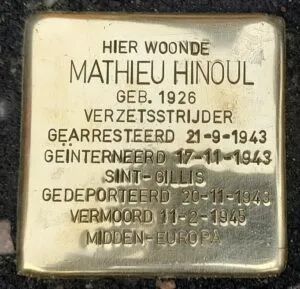
Stumbling stones, better known as Stolpersteine, are small, concrete memorials with a brass plaque placed in front of the former homes of victims of the Holocaust and other Nazi persecutions. The initiative comes from the German artist Gunter Demnig, who wants to keep the memory of the victims alive with these discreet and poignant little monuments. Each stone bears the name of a person, his or her date of birth, date of deportation and, if known, place and date of death.
Stumbling stones in Bruges
Bruges now has dozens of trip-stones scattered throughout the city. They commemorate the Jewish residents, political prisoners and resistance fighters who were taken away during World War II and never returned. By embedding the stones directly in the sidewalk, they invite passersby to pause and reflect on the atrocities of the past. The idea behind the Stolpersteine is that people figuratively “stumble over” them and in this way ensuring that the names and stories of the victims are not forgotten.
Mathieu Hinoul
Mathieu Hinoul was a young resistance fighter from Bruges who was active in the Revolutionary People’s Youth during World War II. He was arrested in 1943 and deported to various camps. Ultimately, he died while en route to Bergen-Belsen. His Stolperstein in Assebroek commemorates his courageous struggle against the Nazis.
Collective memory
Every unveiling of a Stolperstein in Bruges is accompanied by a solemn ceremony, where relatives, historians and residents come together to keep the memory alive. This initiative contributes to the city’s collective memory and raises awareness among both residents and visitors. Historical societies and local governments work closely together to document the stories behind the names, ensuring that future generations continue to understand what happened at the time.
What makes these Stolpersteine so special is their simple yet powerful message. Unlike large monuments, such as statues or plaques, they are modest and fit seamlessly into the streetscape. This makes confronting them spontaneous and unexpected. Often people only notice them after a second glance, leading to curiosity and ultimately awareness. Through this subtle form of remembrance, history remains integrally intertwined with the modern city.
Want to know more about these Bruges Stolpersteine or about the resistance in Bruges during World War II? Our guide will be happy to introduce you to the Stolpersteine in the city center and the history of the resistance. Book your S-wan tour here.